Introduction
Global financial markets have entered a heightened state of uncertainty following a significant geopolitical escalation between the United States and Iran. Recent statements from Donald Trump confirm the initiation of a maritime blockade targeting Iranian-linked shipping routes, marking a sharp shift from diplomatic engagement to strategic confrontation.
At the center of this development lies the Strait of Hormuz — a vital artery for global energy supply. Any disruption in this region carries immediate and far-reaching consequences across commodities, currencies, and equity markets.
Geopolitical Context: From Negotiation to Confrontation
The latest escalation follows the collapse of US–Iran peace talks, which had initially raised hopes for de-escalation. However, the shift toward military and economic pressure signals a more aggressive policy stance.
Iranian officials have responded by warning of “unused levers” that could be deployed against any blockade measures, raising the risk of retaliatory actions and prolonged instability in the region.
This transition from diplomacy to confrontation has significantly increased the geopolitical risk premium embedded in global markets.
Market Reaction: A Classic Risk-Off Shift
Oil Markets Surge on Supply Concerns
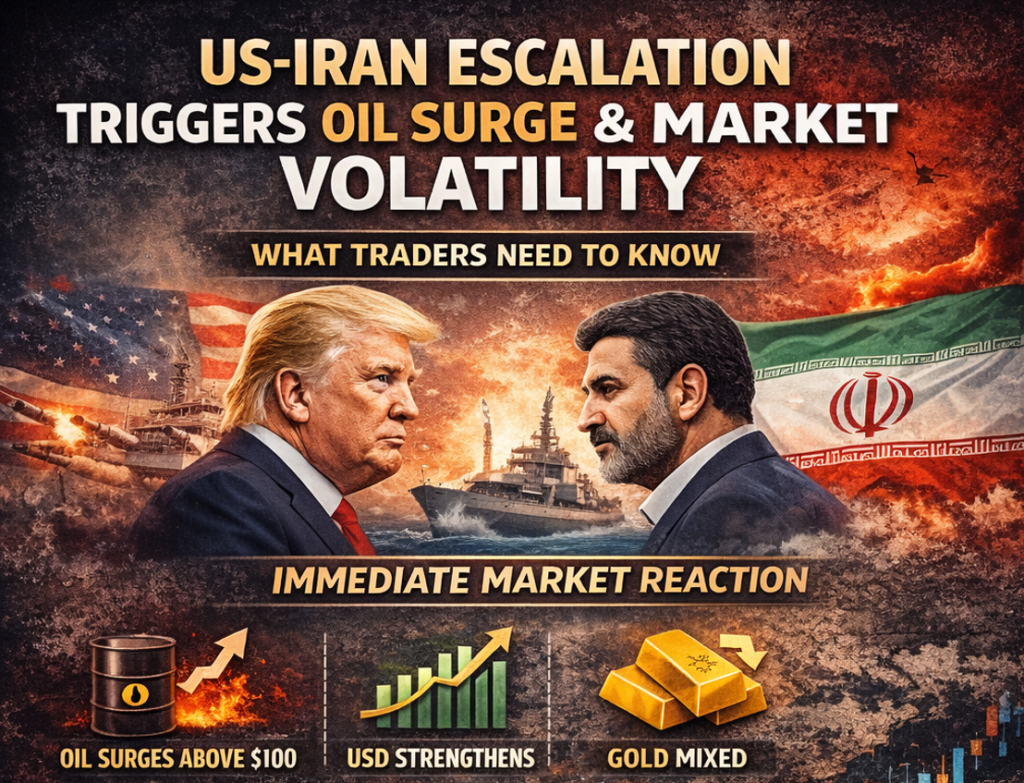
Crude oil prices have reacted sharply, breaking above the $100 per barrel mark as traders price in potential supply disruptions. The Strait of Hormuz facilitates a substantial portion of global oil transit, and any restriction amplifies fears of constrained supply and rising energy costs.
US Dollar Strengthens as Safe-Haven Demand Rises
The US dollar has gained strength amid the uncertainty, benefiting from its status as a global reserve currency. Investors have rotated capital toward liquidity and safety, reinforcing bullish momentum in the #dollar index.
Gold Shows Mixed Signals
Gold initially attracted safe-haven flows but faced downward pressure due to the strengthening dollar. This divergence highlights the complex interplay between competing safe-haven assets in periods of geopolitical stress.
Equity Markets Turn Volatile
Global equity markets have shown increased volatility, reflecting uncertainty around economic stability, inflation, and potential escalation. Risk-sensitive assets remain vulnerable to further downside if tensions intensify.
Forex Market Implications
The foreign exchange market is currently being driven by macro risk sentiment rather than traditional economic indicators.
- EUR/USD and GBP/USD face downward pressure due to dollar strength
- JPY and CHF are likely to benefit as alternative safe havens
- Commodity-linked currencies such as AUD and CAD remain sensitive to oil price dynamics
This environment favors short-term tactical trading rather than long-term directional conviction.
Strategic Importance of the Strait of Hormuz
The Strait of Hormuz is one of the most critical chokepoints in global trade. Approximately one-fifth of the world’s oil supply passes through this narrow corridor.
Any disruption here does not merely impact regional markets—it has global implications, influencing inflation, central bank policy, and overall economic stability.
Trading Considerations in a High-Risk Environment
Periods of geopolitical tension require a disciplined and adaptive trading approach.
Key Principles:
- Prioritize risk management over aggressive positioning
- Avoid trading purely on headlines without confirmation
- Focus on market structure and liquidity zones
- Expect increased volatility and potential false breakouts
In such conditions, capital preservation becomes as important as profit generation.
Outlook: What Comes Next?
Market participants should closely monitor the following developments:
- Iran’s official response and potential countermeasures
- Escalation or de-escalation in military activity
- Continued movement in oil prices
- Central bank reactions to inflationary pressures
These factors will determine whether current volatility evolves into a sustained trend or remains event-driven.
Conclusion
The US–Iran situation represents a critical inflection point for global markets. The shift from diplomatic engagement to strategic escalation has introduced a new layer of uncertainty, driving volatility across asset classes.
For traders and investors, the key takeaway is clear:
Markets are now being driven by geopolitical risk as much as, if not more than, economic fundamentals.
Navigating this environment requires discipline, patience, and a strong focus on risk control.
Pro Insight
In high-impact geopolitical markets, execution matters less than positioning discipline.
Those who manage risk effectively will remain in the game long enough to capitalize on opportunity.