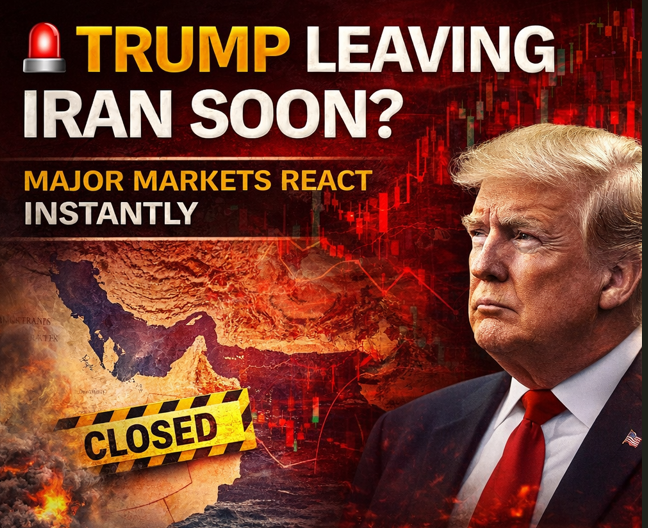
Global markets are once again reacting to a major geopolitical headline: reports suggest that Donald Trump has indicated that the United States will be “leaving Iran very soon.”
This statement has introduced fresh uncertainty into already volatile financial markets, particularly impacting forex, gold, and oil trading. For traders, such geopolitical developments are not just headlines they are market-moving catalysts that can create both opportunities and risks.
In this article, we analyze what this statement means, how markets are reacting, and what traders should expect next.
Understanding the Current Situation
The ongoing conflict involving Iran has been a major driver of global market volatility. The possibility of a sudden U.S. exit raises critical questions about stability in the region.
What Does “Leaving Iran” Mean?
The statement suggests:
- A potential de-escalation of military involvement
- A shift toward diplomatic or indirect strategies
- Reduced immediate conflict pressure
However, the lack of clarity has created confusion among traders and analysts alike.
Market Reaction to the News
Financial markets responded instantly to this development, highlighting how sensitive they are to geopolitical signals.
Forex Market Reaction
The forex market showed mixed movement:
- USD experienced volatility due to uncertainty
- Risk-sensitive currencies (AUD, NZD) showed strength
- Safe-haven currencies like JPY gained traction
This reflects a typical pattern where traders reposition based on perceived risk levels.
Gold (XAU/USD) Movement
Gold reacted strongly as traders rushed toward safe-haven assets.
- Increased buying pressure
- Short-term bullish momentum
- High volatility during news release
Gold remains a key asset during geopolitical uncertainty.
Oil Market Impact
Oil markets showed unstable behavior:
- Initial uncertainty caused price fluctuations
- Concerns remain about supply disruptions
- Market direction depends on future developments
The Middle East plays a critical role in global energy supply, making oil highly sensitive to such news.
Trader Sentiment and Market Psychology
One of the most notable aspects of this situation is trader sentiment. Across trading platforms, reactions have been highly polarized:
- Some traders see this as bullish for markets
- Others believe it reflects policy inconsistency
- Many are concerned about market manipulation and unpredictability
Why Sentiment Drives Markets
In short-term trading:
- News > Technical analysis
- Emotions > Logic
This leads to sharp price movements, especially during high-impact events.
Is This Bullish or Bearish for Markets?
The answer is not straightforward.
Bullish Scenario
- Reduced war risk
- Improved global sentiment
- Equity markets gain strength
Bearish Scenario
Uncertainty remains unresolved
Oil supply concerns persist
Inflation pressures continue
Trading Strategy in This Environment
For traders, this is a high-risk, high-opportunity environment.
Focus on Gold During Uncertainty
Gold tends to perform well when uncertainty rises. Look for:
- Breakouts
- Pullbacks in uptrend
Watch Forex Volatility
Currency pairs will react quickly to headlines:
- Trade only confirmed setups
- Avoid impulsive entries
Apply Strict Risk Management
This is critical:
- Use stop-loss on every trade
- Risk only 1–2% per trade
- Avoid over-leveraging
What Traders Should Watch Next
The market now depends on what happens next:
Key Factors to Monitor
- Official confirmation of U.S. withdrawal
- Iran’s response
- Oil supply conditions
- Central bank reactions
Any new development can trigger another wave of volatility.
Long-Term Impact on Markets
If the U.S. exits Iran:
Forex
- Increased volatility
- Shifts in USD strength
Gold
Continued demand if uncertainty persists
Oil
- Highly dependent on regional stability
- Risk of supply disruption remains
Conclusion
The statement that the U.S. may soon leave Iran has added another layer of uncertainty to global markets. While it may signal a potential de-escalation, the lack of clarity keeps traders cautious.
For forex and gold traders, this is a reminder that geopolitics can override everything else including technical analysis. Staying informed, managing risk, and avoiding emotional decisions will be key to navigating this environment.